
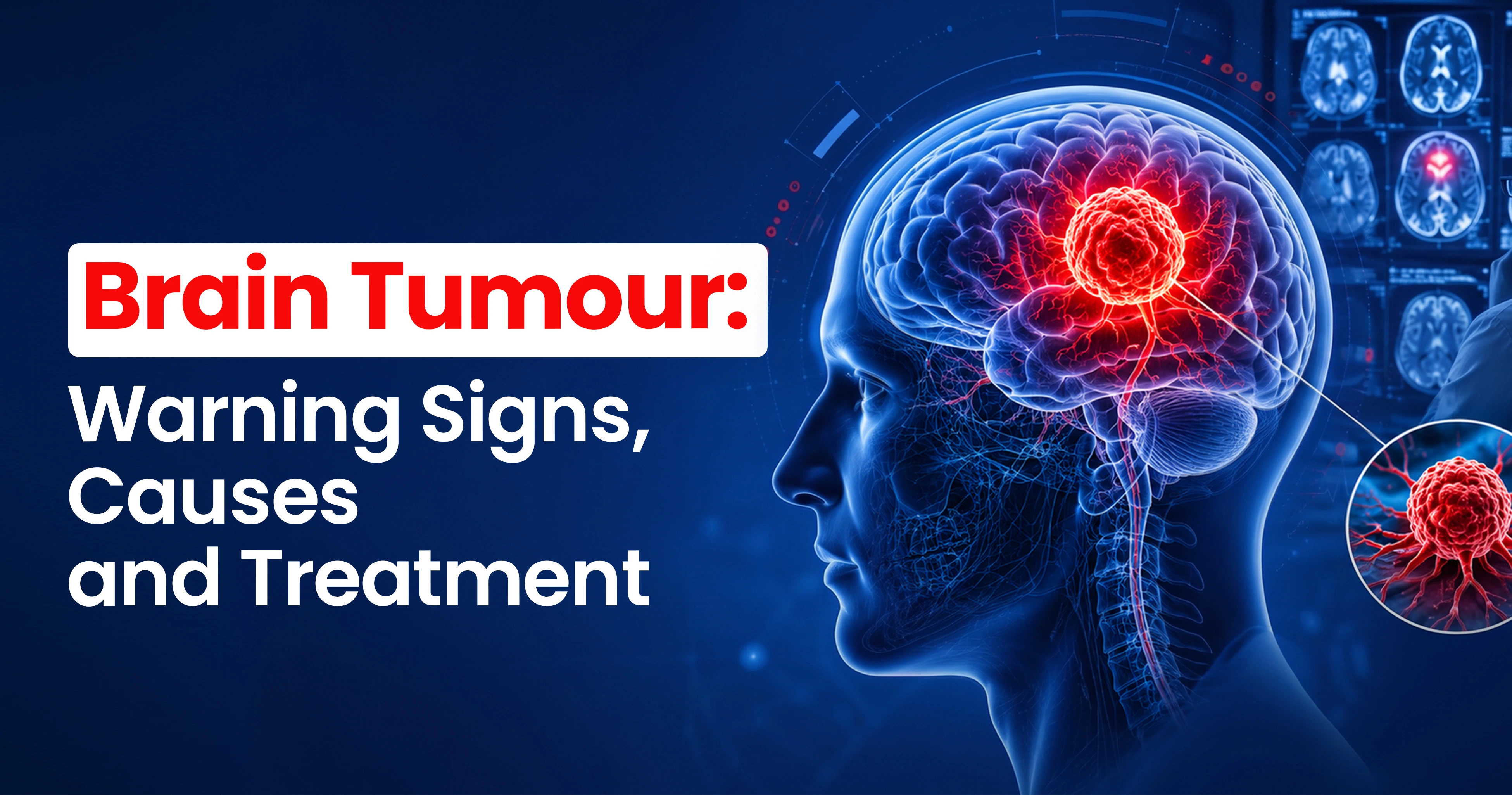
Brain Tumour: Warning Signs, Causes and Treatment
A sudden or unusual headache can be frightening, but the reassuring truth is that most headaches are not caused by a brain tumour. Brain and central nervous system tumours are relatively rare, with a global incidence of around 6 per 100,000 people each year. In India, published hospital-based data suggest a similar incidence, ranging from 5 to 10 per 100,000 people, and accounting for around 2% of all cancers nationally. Even so, some warning signs deserve attention.
A brain tumour can grow quietly, so spotting the early symptoms can make a real difference to treatment and recovery. This guide explains what a brain tumour is, what causes it, the warning signs you should not ignore, how it is diagnosed and the modern treatment options available, including the neurosurgery care offered at A.J. Hospital and Research Centre in Mangalore.
Key Takeaways
-
Most headaches are harmless, yet persistent or worsening symptoms need a medical review.
-
A brain tumour can be benign (non-cancerous) or malignant (cancerous) and both types may need treatment.
-
Common warning signs include morning headaches, vomiting, seizures, vision changes and limb weakness.
-
An MRI scan is the preferred test for diagnosing a brain tumour.
-
Treatment may combine surgery, radiotherapy and chemotherapy.
-
Awake craniotomy and neuro-navigation make modern tumour surgery safer.
-
AJ Hospital, Mangalore, offers dedicated neurosurgery care from diagnosis to recovery.
What Is a Brain Tumour
A brain tumour is an abnormal growth of cells inside the brain or the tissues close to it. The body normally makes new cells in a controlled way to replace old or worn-out ones. When this process goes wrong, cells divide without stopping and form a mass known as a tumour.
Normal cells follow clear signals that tell them when to grow and when to stop, but tumour cells ignore these signals. They keep growing, take up space and can press on nearby parts of the brain. Because the skull is a fixed enclosed space, even a small growth can raise the pressure inside the head and affect how the brain works. It may begin in the brain itself as a primary tumour or spread from cancer elsewhere in the body as a secondary tumour.
Benign vs Malignant Brain Tumours
Not all tumours are cancerous. Doctors group them broadly into two types. A benign brain tumour is non-cancerous, usually grows slowly and tends to stay in one place. A malignant brain tumour is cancerous, often grows faster and can invade nearby healthy tissue.
Even a benign brain tumour can be serious, because if it grows in a sensitive area or presses on vital structures, it can still cause significant symptoms and may need treatment.
|
Feature |
Benign Brain Tumour |
Malignant Brain Tumour |
|
Growth rate |
Usually slow |
Often fast |
|
Spread |
Stays in one place |
Can invade nearby tissue |
|
Borders |
Usually clear |
Often irregular |
|
Recurrence |
Less likely |
More likely |
|
Treatment |
May still be needed |
Usually needed promptly |
Brain Tumour Causes and Risk Factors
In most cases, the exact cause is not known. Research has found some factors that may raise the risk, although having a risk factor does not mean a person will develop a tumour. The main brain tumour causes and risk factors are listed below.
-
Genetic and hereditary conditions such as neurofibromatosis and Li-Fraumeni syndrome, along with a family history of these tumours.
-
High-dose radiation exposure, usually from previous radiotherapy to the head, is given for another cancer.
-
Certain viral infections and a weakened immune system which some studies link to a higher risk.
-
Increasing age, although brain tumours can affect people of any age, including children.
For most people, no clear reason can be found and the tumour appears to develop by chance through random changes in cell DNA.
Do Mobile Phones Cause Brain Tumours
Few health questions cause as much worry as whether mobile phones cause them, yet the current scientific evidence is reassuring. A large systematic review commissioned by the World Health Organisation and published in Environment International in 2024 examined 63 studies carried out between 1994 and 2022. It found no association between mobile phone use and brain cancer, even among people who had used phones for ten years or more.
Mobile phones, Wi-Fi and Bluetooth devices give off a low-energy radiation called non-ionising radiation. The energy levels are considered too low to damage DNA or to cause the cell changes that lead to cancer, which is different from high-energy ionising radiation such as X-rays. You can read the WHO-commissioned review for the full findings. While research continues, you can use your phone without undue fear that it will cause a tumour.
Brain Tumour Warning Signs You Should Not Ignore
Most tumour symptoms come from raised pressure inside the skull or from the tumour affecting a particular part of the brain. They often appear gradually and can be mistaken for other conditions. The following warning signs deserve attention, especially when they are new, persistent or getting worse.
-
Persistent headaches that do not settle with usual remedies
-
Early morning headaches, sometimes with nausea
-
Headaches that wake you from sleep
-
Double or blurred vision
-
Persistent or unexplained vomiting
-
Seizures, especially for the first time in adulthood
-
Speech difficulties, such as slurred or muddled words
-
Weakness or numbness in the arms or legs
-
Memory changes or increasing confusion
-
Personality or behaviour changes noticed by family
A brain tumour headache is often worse in the morning, may worsen with coughing or bending and tends to become more frequent over time. A single symptom is rarely a cause for alarm, but a combination of these signs or any symptom that steadily worsens should be checked by a doctor.
Brain Tumour Symptoms by Location
The brain controls different functions in different areas, so the symptoms often reflect where the tumour is growing. The table below shows some common examples.
|
Brain Area |
Possible Symptoms |
|
Motor cortex |
Weakness or paralysis on one side of the body |
|
Speech centre |
Difficulty speaking or finding the right words |
|
Frontal lobe |
Changes in personality, behaviour or judgement |
|
Occipital lobe |
Blurred vision or loss of part of the visual field |
|
Cerebellum |
Problems with balance and coordination |
How a Brain Tumour Is Diagnosed
If a tumour is suspected, a neurologist or neurosurgeon will carry out a series of tests to confirm the diagnosis and plan treatment. Brain tumour diagnosis usually involves several of the steps below.
-
Neurological examination to check vision, hearing, balance, reflexes, muscle strength and coordination.
-
MRI scan, the preferred test, which gives detailed pictures of soft tissue without using radiation. A brain tumour MRI shows the size, location and borders of a tumour clearly.
-
CT scan, which is quick and useful in emergencies or when an MRI is not suitable.
-
A PET scan, which helps show how active a tumour is and whether it has spread.
-
EEG, which records the electrical activity of the brain and helps when seizures are present.
-
Biopsy, where a small tissue sample is examined under a microscope to confirm the type and grade.
MRI is usually preferred because it shows soft brain tissue in fine detail and helps tell different tumour types apart, all without exposing the patient to radiation.
Brain Tumour Treatment Options
Brain tumour treatment depends on the type, size, grade and location of the tumour as well as the person's general health. In many cases, a combination of treatments works best, planned by a team of neurosurgeons, radiation oncologists and medical oncologists.
-
Brain tumour surgery is often the first step. The aim is to remove as much of the tumour as safely as possible while protecting healthy brain tissue and for some tumours, complete removal can be curative.
-
Microsurgery uses a high-powered operating microscope so the surgeon can see fine structures clearly and remove the tumour with great precision.
-
Radiotherapy uses high-energy beams to destroy tumour cells or control any cells left behind after surgery.
-
Chemotherapy uses medicines to kill tumour cells or slow their growth. Temozolomide is commonly used for certain malignant brain tumours, often given together with radiotherapy.
The right combination is decided for each patient, balancing the best chance of controlling the tumour with the need to preserve quality of life.
Advanced Neurosurgery Technologies
Modern neurosurgery uses a range of technologies that make tumour surgery safer and more precise. These tools help the surgeon remove as much tumour as possible while protecting the parts of the brain that control movement, speech and other vital functions.
-
Neuro-navigation works like a GPS for the brain, combining scans taken before surgery with real-time tracking to plan the safest route to the tumour.
-
Awake craniotomy allows surgery near speech or movement areas while the patient is awake and comfortable, which can greatly reduce the risk of long-term problems.
-
Motor mapping uses gentle electrical stimulation to identify and protect the areas that control movement.
-
Fluorescence-guided surgery uses a special dye that makes tumour cells glow, helping the surgeon see the edges of the tumour.
-
Intraoperative ultrasound gives live images during surgery so the surgeon can check how much tumour has been removed.
Brain Tumour Treatment in Mangalore at AJ Hospital
For people seeking brain tumour treatment in Mangalore, AJ Hospital and Research Centre offers a dedicated neurosurgery service supported by modern technology and a multidisciplinary team. The neurosurgery department is led by experienced consultants, including Dr Rakshith Kumar Shetty, who has more than 17 years of neurosurgical experience and has performed around 4,000 brain and spine surgeries. He trained at NIMHANS in Bengaluru and completed a fellowship in cerebrovascular and skull base neurosurgery at the University of Washington in Seattle.
The department is equipped for advanced procedures such as neuro-navigation guided surgery and awake craniotomy, with operating microscopes, ultrasonic tumour removal systems and endoscopes for minimally invasive surgery. A team of neurosurgeons, oncologists, radiologists and rehabilitation specialists works together from diagnosis through recovery, so an early consultation can help clarify the cause of symptoms and guide the next steps.
Frequently Asked Questions
Early signs can include new or worsening headaches, nausea, blurred or double vision, seizures, limb weakness and changes in memory or behaviour. These symptoms are often gradual and worth checking if they are persistent or getting worse.
Yes, but most headaches are not caused by a tumour. A brain tumour headache is more likely to be persistent, worse in the morning, worse with coughing or bending and often joined by other symptoms such as vomiting or vision changes.
Current evidence does not support a link. A large World Health Organisation review published in 2024 found no association between mobile phone use and brain cancer. The radiation from phones, Wi-Fi and Bluetooth is too low in energy to damage DNA.
No. Many brain tumours are benign, which means they are non-cancerous and slow-growing. A malignant brain tumour is cancerous and tends to grow faster. Even a benign tumour can cause problems if it presses on important areas, so all tumours need proper assessment.
Diagnosis usually begins with a neurological examination followed by imaging. A brain tumour MRI is the preferred test because it shows brain tissue in fine detail. A CT scan, PET scan or biopsy may also be used to confirm the tumour type.
Awake craniotomy is brain surgery carried out while the patient is awake and comfortable. It is used for tumours near areas that control speech or movement, helping the surgeon protect these functions and reduce the risk of lasting problems.
Some can. Many benign tumours can be completely removed with surgery, offering a cure. Malignant tumours are harder to cure, but treatment can often control the disease, relieve symptoms and improve quality of life.
Recovery varies from person to person. Many people feel tired for several weeks and may have headaches or difficulty concentrating at first. A general recovery often takes a few weeks to a couple of months and further treatment can extend this.
See a doctor or neurosurgeon if you have persistent or worsening headaches, a first-time seizure, ongoing vomiting, vision or speech problems, limb weakness or noticeable changes in memory or behaviour. Early assessment matters most when several of these signs occur together.
Conclusion
A brain tumour can be a frightening prospect, but understanding the warning signs puts you in a stronger position. Most headaches are harmless, yet persistent or worsening symptoms such as new seizures, ongoing vomiting, vision changes or limb weakness should never be ignored. Early detection allows for simpler treatment and better outcomes, whether the tumour is benign or malignant. Modern brain tumour treatment, supported by advanced surgical technology, offers real hope for many patients.
|
Worried about symptoms that will not go away? The neurosurgery team at AJ Hospital and Research Centre, Mangalore, is here to help. Book a consultation today for an expert assessment, accurate diagnosis and a personalised brain tumour treatment plan. Connect With Our Team |